12 Fair Participation Routines Using a Random Name Picker
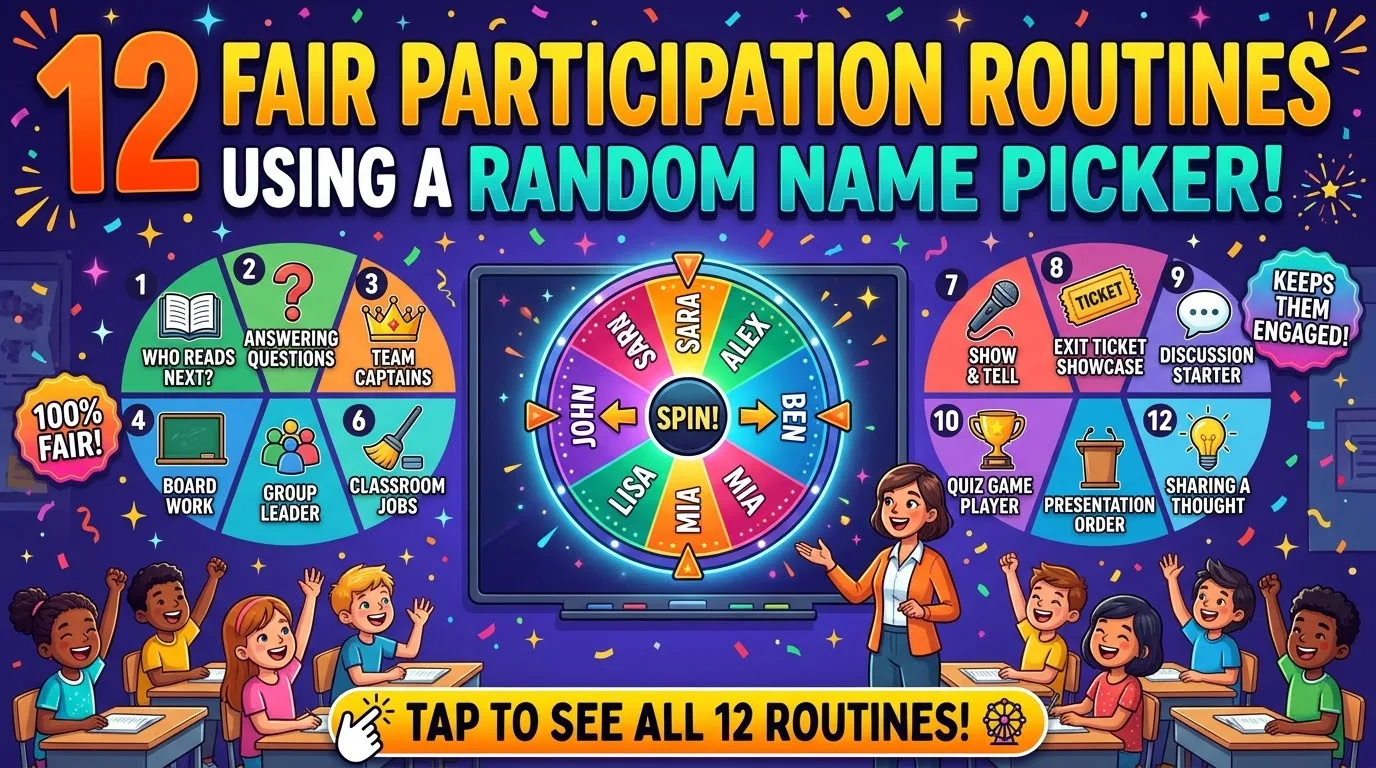
12 Fair Participation Routines Using a Random Name Picker, Here are twelve different routines you can follow when using a random name picker as a tool for fair participation in class. However, you will need to think through each of these participation ideas to determine if they would work in your particular classroom environment.
For example, should there be a period of time between asking the question and spinning the picker? Should there be ways to protect nervous students? How can you ensure all voices are heard?
By Malik Aiesh Bahadur,
Why use a name picker at all?
Teachers tend to call on the same hands. This is not a character flaw. Confident students answer quickly, they are visible, and the lesson progresses. If you only hear from volunteers, you are measuring who volunteers, an activity never entirely divorced from popularity contests. Dylan Wiliam is frequently quoted on that subject in the context of formative assessment.
A picker eliminates the habit. Students know a call might come and think through every question. It also eliminates any sense of your favoring someone by virtue of the process itself.
It works best in a routine. Students know how it works and that a pass is an option, so being picked is a non-event. If you are preparing for the first time, how to make a spin wheel in 60 seconds requires a minute, and what is a wheel of names covers the basics.
Three rules that make every routine better
Question first, name second. Ask the question to the whole class, and then spin. If you call a name first, the class stops thinking.
Pause before you spin. Research on wait time (going back to Mary Budd Rowe in the 1970s) shows that, on average, students are likely to give better answers to a question if they get about three seconds of silence after the question. Count it out. It feels long.
Random who, designed what. The picker picks the student; you pick the question. Match the difficulty of the question to the ability level of the student you think will be the most successful with a stretch, and save the hardest questions for when the class has context to understand them. The wheel decides fairness. It shouldn't decide who is primed for failure.
The 12 routines
1. The retrieval warm-up
At the beginning of the lesson, write one question on the board about the previous lesson. Let the students ponder for 30 seconds and then spin the wheel. The chosen student must answer the question. It helps them to remember and makes the class start actively. Choose different students for three questions.
2. Think, pair, then spin
Ask a question, give students a minute to discuss with a partner, and then have one of the students in the pair report their answer to you. Having practiced their response with a peer, students feel more comfortable. Try this strategy with classes that are used to spontaneous questioning routines.
3. Spin after the pause
The simplest form. Question, wait three seconds, spin, call. Every student has had a chance to think and no one knows who will have to go next. It is the foundation of everything else.
4. The warm call
Spin in advance and tell the student quietly, "I'm going to ask you about question 4 in a few minutes." They will be given time to think it through, which is good for those who need to contemplate an answer or for those using English as a second language. There is no pressure because it was a spin, so the student won't feel that you are targeting him/her.
5. The pass and return
Allow a pass per term per student. Once a student passes, their name goes back on the wheel for future lessons. A pass is rarely used as soon as students are aware it is an option, and takes pressure off of cold calling as an unfair practice.
6. Phone a friend
The preferred student can ask his classmate for help. That classmate will have to explain to him, not give away the answer. This turns it into a cooperative situation, good for any situation requiring reasoning.
7. Exit ticket sampling
At the end of the lesson, students write one response on paper. Spin 3 names, have those students share their answer. Quick formative assessment that doesn't take much time, but still allows students to know their paper might be picked.
8. Turn-taking for reading aloud
Place each name on the wheel with removal on, and call people in the order they come up on. Everyone gets read once before anyone repeats, and the system maintains order. Discover how to stop a wheel from calling repeats.
9. The quick-fire review round
Prepare 10 short questions. Spin a name for each question with removal on so that each of ten different students answers. It is quick and fun and gets you feedback from many people in 5 minutes.
10. The board volunteer
When a problem has to be done on the board, let the wheel decide who has to go up. Provide an option to choose a partner. This stops the same, confident students from going up every time.
11. Peer feedback pairs
Spin two names at a time to make feedback partners for a piece of writing or a draft. Random pairs mix friendship groups, which tends to give more honest feedback. For bigger groups, use the Random Team Generator, and see the fair teams guide.
12. Weekly class jobs
Spin once a week to assign roles such as materials monitor, timekeeper, door holder. Jobs are marked as Removal on and everyone will have every job over the term. Students stop asking whose turn it is, because the wheel answered their questions.
Check that it is actually fair
Teachers who think that they are calling on everyone equally are often surprised at the data. A name picker helps, but only if you examine it.
Keep a tally sheet and write each student's name along the side and make a tally mark every time they answer a question in a lesson. After two weeks, examine it. If some students have six marks while others have none, determine why. Were some students absent? Was removal disabled? Or did you just stop using the name picker when the lesson got behind?
It can also be used as a lesson. Demonstrate how and why the random picker with replacement works, explaining that duplicates are expected. In a class of 25, if you spin 25 times with replacement, 9 students on average will not be called at all. Have your students predict how many they think will not be called, then try it. It is an exercise in probability but serves as an effective lesson as to why removal is a good idea, far better than any lecture you could provide.
- How to Make a Spin Wheel in 60 Seconds
- Pseudo-Random vs True Random: What Teachers and Giveaway Hosts Need to Know
- How to Cold Call Without Embarrassing Students (With a Random Name Picker)
- 10 Vocabulary Review Games You Can Play With a Spin Wheel
Adjusting by age
For younger children, make it brief and light. Let them take turns pressing the button, counting down and cheering for their peers. Call out first names only.
For older students, justify its use. Teens likely to be ok with random calling as long as they know it is fair, and not a ploy to get them to speak. Btw, offering a pass may help.
For virtual, you need to show the draw on screen, and explain to students that unmuting pauses are to be expected. Maybe have a ready-made order in the chat as a backup if the tool is lagging.
When not to use random calling
A picker is not the right tool for every student at every point. And there are a couple of reasons for that. Some students find being called on very challenging (not that this is a problem), and this can be for reasons including things like the anxiety, language acquisition or individual learning styles. And if a student has a support plan, then they should follow that, using warm calls, written answers or agreed signals instead.
It also shouldn't be used as a discipline tool. If your students know that the wheel is going to be used to catch them out, it loses the trust that makes it work.
And finally a point on names on screen. If you are projecting your wheel, it's worth using first names or initial only, and considering what you're comfortable with. I'll take a deeper dive into student privateness in a separate article.
Frequently asked questions
How do I use a random name picker in the classroom?
dd your class list to the wheel, ask a question to the whole class, wait three seconds, then spin and call the student whose name comes out. Turn on the option to remove a name once they have answered so that everyone gets a turn before repeats.
Is random name picking fair?
It's more fair than asking volunteers or calling on people who remember the material, because everyone has an equally likely chance. To be completely fair, keep a tally of who has answered.
How do I stop the same student being picked twice?
Turn on the option to remove each winner from the pool, and reshuffle the list when everyone has had a turn.
Should students be allowed to pass?
Yes, once per term or per lesson. As long as they put their name back on the wheel, they can still get another turn.
Does cold calling embarrass students?
It can be if you do it unexpectedly or as a trap. Use warm calls and give them time to think. Allow them to pass and ask a question they know the answer to. I talk about how to cold call without embarrassing students here.
Can I use it in an online class?
Yes, as long as you share your screen so they can see the draw.
Try it
Open the Spin Wheel and paste the list of first names from your class into the text box, then try this routine 3 tomorrow! Explore the templates to discover classroom wheels to personalize. For presentation order, the Random Order Generator can speed things up even more than individually spinning names.