30 Two-Minute Brain Breaks for a Spin Wheel
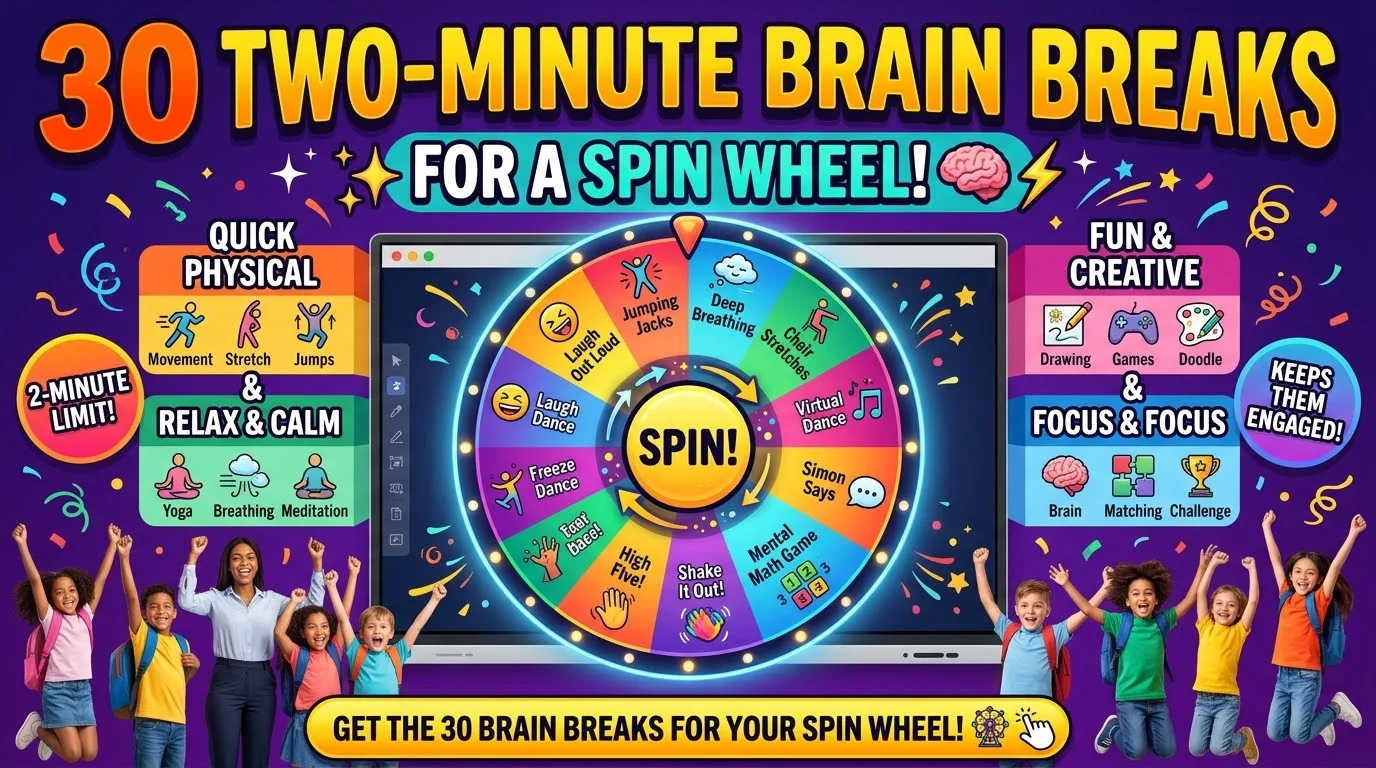
30 Two-Minute Brain Breaks for a Spin Wheel Brain breaks are short planned interruptions to a lesson which give students an opportunity for physical activity, relaxation or refreshing their minds. Below are 30 ideas that have taken approximately two minutes to complete, require minimal preparation and are divided into four categories to give you options to suit your classroom. Simply place on a wheel and spin!
By Malik Aiesh Bahadur
Why use a wheel for brain breaks?
Most teachers will have a couple of quick activities that they use and make students moan about. Using a wheel means that there is more variety, no decision making needed and children enjoy the slight suspense. It makes the break something to look forward to.
In terms of evidence, most research into brief physical activities show only slight improvements in attention and on task behaviour. This can depend on the age of children and how the activity is carried out. However, if done well, 2 minutes is an inexpensive activity that is usually well received and often worth doing.
Match the wheel to the room
This is the most useful idea in the article. Don’t do all 30 breaks on one wheel. Make 4 little wheels, one for each type of break. Then pick which wheel you want to use depending on how your class is feeling. The wheel will then randomly select an activity for you.
|
The class feels |
Use this wheel |
|---|---|
|
Sleepy, flat, after lunch |
Energize |
|
Scattered or distracted |
Focus |
|
Wired, upset or overstimulated |
Calm |
|
New group, or tension in the room |
Connect |
Keep the number of entries on each wheel to between 6-10 so you can still see the labels. To create your spin wheel in 60 seconds. Enable the remove option so that each spin will cycle through all the breaks in the class. How to prevent your wheel from spinning the same winners.
Energize: wake the room up
|
# |
Break |
What to do |
Noise |
Needs |
|---|---|---|---|---|
|
1 |
Jumping jacks |
20 jumping jacks, counting together. Seated option: arm circles |
Medium |
Space to stand |
|
2 |
Stand if |
Say statements such as "Stand up if you like pizza." Everyone sits again after each one |
Low |
None |
|
3 |
Cross crawl |
Touch right elbow to left knee, then left elbow to right knee, for 30 seconds |
Low |
None |
|
4 |
Freeze dance |
Play music for 60 seconds. Everyone freezes when it stops |
High |
Music |
|
5 |
Four corners |
Label the corners of the room. Use a second wheel to choose a corner. Students in that corner sit down |
Medium |
Space |
|
6 |
Simon says |
A quick round for 2 minutes |
Low |
None |
|
7 |
Shake it out |
Shake hands, arms, legs and head, counting down from 10 to 1 |
Low |
None |
|
8 |
Desk push-ups |
10 push-ups against the desk or wall |
Low |
None |
|
9 |
Rock paper scissors tournament |
Pairs play, winners find new winners and so on |
Medium |
Space |
|
10 |
Stretch tall |
Reach up, bend to each side and touch toes, slowly |
Low |
None |
Focus: bring attention back
|
# |
Break |
What to do |
Noise |
Needs |
|---|---|---|---|---|
|
11 |
Silent ball |
Toss a soft ball around the room without speaking. A drop or a word is just a laugh |
Low |
Soft ball |
|
12 |
Count back |
Pairs count backwards from 50 by threes |
Low |
None |
|
13 |
Mirror me |
Partners copy each other's movements as if in a mirror |
Low |
None |
|
14 |
Heads down, thumbs up |
A few students tap shoulders and others guess who tapped |
Low |
None |
|
15 |
Other hand drawing |
Draw a house or an animal with the hand you do not write with |
Low |
Paper |
|
16 |
Riddle |
Read a riddle and let students whisper the answer to a partner |
Low |
A riddle |
|
17 |
Rhythm copy |
Clap a pattern and the class repeats it, getting harder each time |
Medium |
None |
|
18 |
Spot the change |
Change three things about yourself or the room and students spot them |
Low |
None |
Calm: settle the room
|
# |
Break |
What to do |
Noise |
Needs |
|---|---|---|---|---|
|
19 |
Box breathing |
Breathe in for 4, hold for 4, out for 4, hold for 4. Three rounds |
Silent |
None |
|
20 |
Five senses |
Name 5 things you see, 4 you hear, 3 you feel, 2 you smell, 1 you taste. Silently or whispered |
Silent |
None |
|
21 |
Shoulder rolls |
Roll shoulders back, stretch the neck gently and relax the hands |
Silent |
None |
|
22 |
Silent minute |
A minute of quiet. Eyes may be closed or looking at one spot |
Silent |
None |
|
23 |
Doodle |
Scribble or doodle freely for 60 seconds |
Silent |
Paper |
|
24 |
One good thing |
Whisper one good thing from today to a partner |
Low |
None |
Some students may feel uncomfortable closing their eyes. It is always good to remind them that they can keep their eyes open and just stare at a point on their desk.
Connect: build the room
|
# |
Break |
What to do |
Noise |
Needs |
|---|---|---|---|---|
|
25 |
Would you rather |
Read a light question and let students move to the left or right side of the room. Use the wheel to choose the question |
Medium |
Space |
|
26 |
Quick compliment |
Turn to a neighbor and say one genuine thing they did well today |
Low |
None |
|
27 |
Handshake greetings |
Greet three classmates each with a different handshake in one minute |
Medium |
Space |
|
28 |
Two truths and a lie |
Pairs play a fast round |
Low |
None |
|
29 |
Fruit salad |
Students swap seats when their fruit is called |
High |
Chairs, space |
|
30 |
Count to twenty |
The class counts to 20, one person at a time, no pattern. If two speak at once, start again |
Low |
None |
A two-minute routine
To ensure that the break is effective you need to make sure it ends. Here is a simple 3 step process.
Notice: Look for behaviour that indicates a break is needed. This could be fidgeting, glassy eyes, increasing noise or slumped shoulders. Tell them it's break time before their energy levels drop.
Spin and shout: Choose the wheel that best matches their mood. Spin the wheel. Announce that its break time. Set the timer for 2 minutes.
Return: Give them a 10 second warning. Tell them it's time to return to their task. You can add a final instruction, such as a deep breath and ‘Back to work’. Ensure that the task is displayed on the board so they know what to do as soon as they sit down.
Many lists miss out this final step. This is where breaks can go wrong. If you're taking 5 minutes to recover from the break then it was too much for the time and wasn't planned properly.
Include everyone
All students should feel safe to participate in the break.
Some students may not want to participate so provide a choice to sit out, watch or do an alternative quiet activity.
Provide a seated option. If the break requires movement provide a seated option such as arm circles or stretches.
Be mindful of students with sensory needs. If you know some students find loud noises, being close to others and eye contact difficult then plan a quiet break.
Never use breaks as a reward or punishment. Often taking a break away from a student who is struggling will make things worse.
Provide some students with a quiet option. A small calm wheel or card can be placed in a quiet area of the room so they can have a 1 minute break on their own.
- How to Make a Spin Wheel in 60 Seconds
- Pseudo-Random vs True Random: What Teachers and Giveaway Hosts Need to Know
- How to Cold Call Without Embarrassing Students (With a Random Name Picker)
- 10 Vocabulary Review Games You Can Play With a Spin Wheel
- 8 Math Fact Practice Wheel Games for Grades K-5
- Group Work Roles Wheel: How to Assign Roles Fairly
For older students
Secondary students often eye roll at anything that feels childish. A short, optional and humorous activity will work well. Using the lists above, good activities for teenagers would be cross crawl, rock paper scissors tournament, would you rather, count to twenty, other hand drawing and box breathing. Get the students to suggest some ideas and include the best ones.
Common mistakes
Too long. If the break runs to five minutes, you have lost a lesson. Use a timer.
The same break every day. Variety is the whole point of the wheel.
Choosing a lively break for a wired class. Match the wheel to the mood.
No plan to return. Have the next task ready.
Forgetting the quiet students. Offer a calm option and do not force participation.
Frequently asked questions
What is a brain break?
Short planned activities to allow students to move around, relax or refresh.
How long should a brain break be?
Two minutes is a good target. Even one minute can help.
How often should I use them?
Many classes will benefit from breaks every 20-40 minutes. The frequency will depend on the age of the child and the activity. Younger children will need more frequent breaks.
Do brain breaks actually work?
Studies have shown short physical breaks can provide small improvements in attention and behaviour. Breaks should be planned and kept short.
What brain breaks work for high school?
Short, optional, low-key ones such as cross crawl, would you rather and rock paper scissors tournaments.
How do I use a spin wheel for brain breaks?
Implement a break by putting the breaks on a wheel. When a break is required spin the wheel and allow the break to run for 2 minutes. Use removal to ensure all the breaks are presented without any repetition.
Try it
Open the Spin Wheel, paste in the Energize list and try one tomorrow after lunch. For more wheel ideas, browse the templates. Group work coming up next? See group work roles wheel.