10 Vocabulary Review Games You Can Play With a Spin Wheel
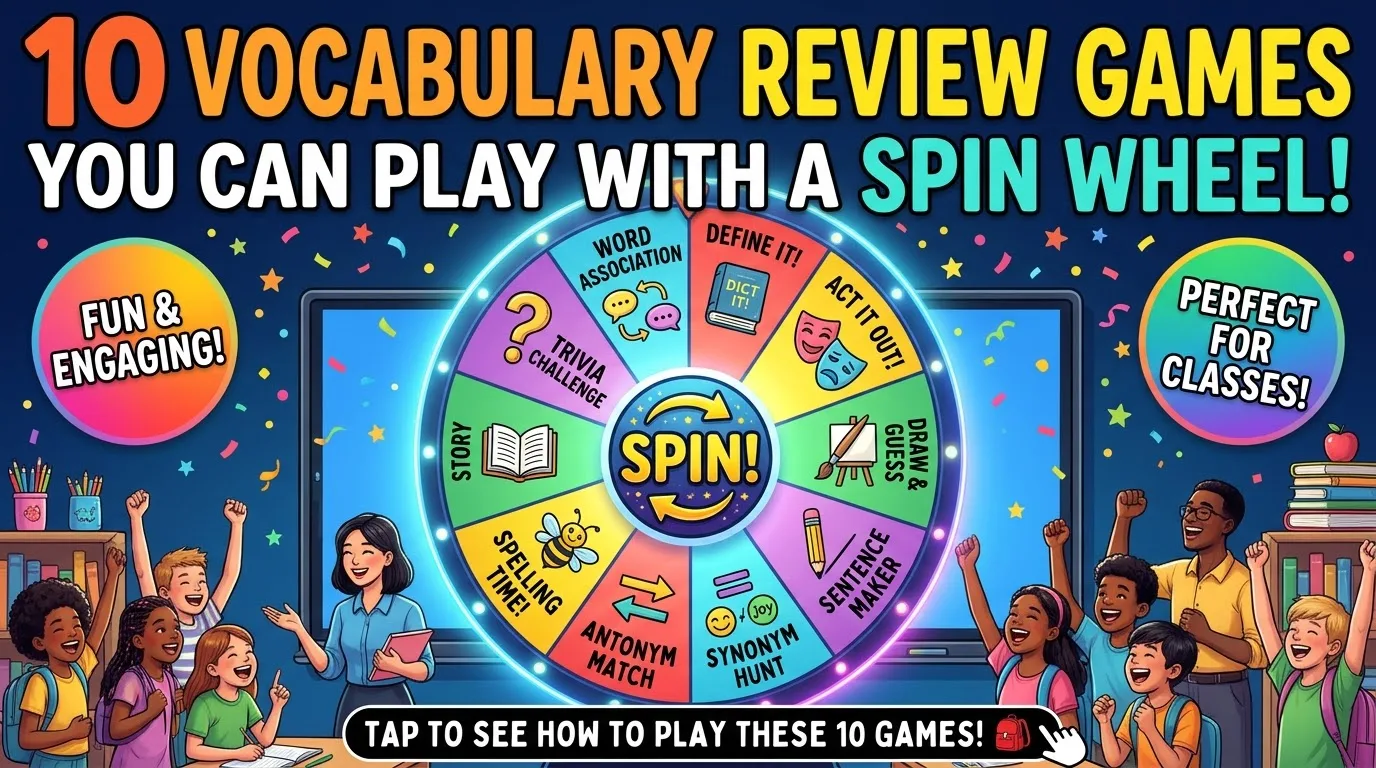
10 Vocabulary Review Games You Can Play With a Spin Wheel A spin wheel can make reviewing vocabulary fun and fast: Simply place your vocabulary words in one section of the wheel and a task prompt in the other, then players take turns spinning the wheel and completing the task that appears.
The 10 games described below take only 5-20 minutes to play, need no printing, and are perfect for primary, secondary and English language classes. Each game includes set-up instructions, how to play, and a modification.
By Malik Aiesh Bahadur,
Why a wheel works for vocabulary
Students learn words through repeated exposure, using and recalling them. A worksheet is silent, easily ignored. A wheel makes recalling fun, a game. Each turn poses a challenge to a student to retrieve a word from memory; a proven technique, according to studies on the science of learning, compared to just reading a list of words.
In addition, a wheel helps address a common issue with practice. It selects the word; you don't have to, and it prevents students from weaning themselves on familiar words.
Build a good word list first
A game is only as good as its words. A few guidelines.
Use 8 to 12 words per wheel. More than that and the labels will be too small to read on a projector. Create multiple wheels for large lists. See how to make a spin wheel in 60 seconds.
Mix new and old words. Include six words from this unit and four from previous units. Mixing increases retention of words learned weeks previously.
Choose the best words. Use high-impact academic words such as analyze, contrast, evidence and impact, which are used across the curriculum.
Keep entries short. Enter the word on the wheel, and keep definitions off the wheel. Students can easily read short entries on a projected wheel; longer entries risk giving away the answer.
Weight the tough ones. If your software permits weights, increase the weight for the words that students keep missing, so they appear more often. See how to do this in weighted spin wheels explained.
Turn on removal after each spin to ensure that each word appears only once. Stopping the wheel after each spin assures that no word will appear twice. See how it works in this video, stopping a spinning wheel.
The 10 games
1. The double wheel
All levels. 10 to 15 minutes. Whole class or pairs.
Create two wheels. The first with your vocabulary words. The second with tasks: define, use in a sentence, synonym, antonym, example, draw, act it out, say it in another language.
The student spins both wheels and completes the task for the chosen word. The game is great because the task is random and even if the students know the word they always have to think about what they will do with it. For an easier version, leave out the more challenging tasks. For a harder version, add in tasks, such as use in a sentence about last week's lesson.
2. Sentence mash-up
Upper elementary and up. 10 minutes. Pairs or whole class.
Spin two words. Students have to write or say a sentence using the two words. The sentence has to make sense. Spinning 'fragile' and 'journey' might yield, "The fragile vase did not survive the journey." Students like getting to stretch their imaginations, and they have to think about the meanings of the words as well as how to put them together.
To make it a competition, give points for each correct sentence and a bonus for the most creative sentence.
3. Definition duel
Middle school and up. 15 minutes. Two teams.
Divide the class into two teams using the Random Team Generator. Spin a word. The first team to give a correct definition scores a point. If they don't have the right definition, the other team can steal the point.
Allow the teams ten seconds to confer before giving their answer so students who hesitate have time to speak up. The fair teams guide has advice on creating balanced teams.
4. Act it or draw it
All levels. 15 minutes. Groups of four.
One student spins in private and sees a word, which they must act out or draw (without letters) while the group guesses. Spin on a device only the performer can see, or cover it up.
Best with concrete objects: erupt, construct or fragile. For abstract words try games 1 or 8.
5. Describe it without saying it
Middle school and up, ESL. 10 to 15 minutes. Pairs
Spin a word. The student has to describe the word so that his/her partner can guess it, without using the word or its first letter. It makes students explain and describe the meaning of the word in their own words, which is much more telling of comprehension than a simple yes/no answer.
For English learners, let them use gestures and simple phrases.
6. Spiral warm-up
All levels. 5 minutes. Whole class.
At the beginning of every lesson, place ten words from previous units on the wheel and spin three times. Students will define or provide an example of the word. Quick, easy, and will keep past vocabulary fresh in students' minds. Used once a week, no word is ever more than 15 minutes away.
7. Category sort
Elementary and up. 10 minutes. Whole class.
Write words on the wheel and decide on categories on the board, like noun, verb and adjective, or topics like weather, feelings and travel. Spin a word, then ask the class what category it fits into and why.
The reasoning is the point. A student who explains what made them choose 'gloomy' as an adjective to do with feelings has learned more than one who simply states the answer.
8. True or false sentence
Upper elementary and up. 10 minutes. Whole class.
Spin a word. Read a sentence using the word, correctly or incorrectly. 'The scientist's hypothesis was proved by the experiment before she began.' Students give a thumbs up or thumbs down indicating if the word is used correctly or not.
Tests whether students know the exact meaning of a word, as opposed to just the general idea. Make two sentences for each word, one correct and one incorrect use.
9. Story chain
All levels. 15 to 20 minutes. Groups of five or six.
Spin a word. Your student adds a sentence or two to a story using that word. Next student spins and adds to the story. After six turns, the group will have created a story with six new words and will read it aloud.
If your wheel has removal on, each word only appears once, making this a great review game that creates a complete story.
10. Make your own wheel
Upper elementary and up. 20 minutes. Groups
Assign your students a set of words from a unit, and have them create a wheel and come up with a task for each entry. Then have groups swap wheels and play each other's games! Creating the wheel itself will challenge students to think about what each word means and how to test that they know it.
You'll also have a nice collection of wheels created by students to use in the next term!
Which games suit which level?
|
Level |
Best games |
|---|---|
|
Ages 5 to 7 |
4, 6, 7 (use pictures with the words) |
|
Ages 8 to 10 |
1, 2, 4, 6, 7, 9 |
|
Ages 11 to 14 |
1, 2, 3, 5, 8, 9, 10 |
|
Ages 15 and up |
2, 3, 5, 8, 10 |
|
English learners |
1 with simple tasks, 4, 5, 6, 7 |
These are my suggestions, so adjust them for your class.
Check that students learned something
A game is fun, but it's not a learning assessment. End with a two-minute exit ticket: Have students write three words from the lesson on the board and use each word in a sentence. This reveals which words students still struggle with so you can assign those words higher priority on the next day's wheel.
- How to Split a Group Into Fair Teams: 3 Methods
- How to Make a Spin Wheel in 60 Seconds
- Pseudo-Random vs True Random: What Teachers and Giveaway Hosts Need to Know
- How to Cold Call Without Embarrassing Students (With a Random Name Picker)
Common mistakes
Too many words. A wheel with 30 entries is just too much. Use multiple wheels.
Definitions on the wheel. Students are reading the answer. They are in their own world.
Spins take too long. If every spin is 15 seconds, you're in trouble. Shorten that spin time.
Same students are answering. Use remove and call on a student by name, or look into random name picker routines for solutions.
No follow up. Just games. No learning. Use the exit ticket.
No device? Make a paper wheel
You can perform any of these without a screen. Draw a circle on a paper plate, split it into segments, write a word on each and spin a pencil or paper clip with your finger. It will be slower and less random, but it will suffice. For the real thing, open the Spin Wheel and paste your list.
Frequently asked questions
How do I use a spin wheel for vocabulary review?
Place your words on the wheel, then spin and ask students to perform a task with that word, such as define it or provide an example.
How many words should I put on a wheel?
Eight to twelve, as too many will make the text too small to read.
Can I use a spin wheel with English learners?
Yes, but use picture prompts, simple tasks and include games that let them gesture, such as acting out a word or describing it.
What are good vocabulary games for large classes?
The double wheel, sentence mash-up and true or false sentence games can be played by an entire class, while pair work means everyone has to play.
How do I make sure everyone learns, not just the winners?
Encourage pair or small group work, call on students at random and finish off with an exit ticket.
Can students make their own vocabulary wheels?
Yes, and it is a good activity. Creating the wheel makes them think about the word's meaning.
Try it
Open the Spin Wheel, paste in ten words from your current unit and try the double wheel. For ready-made lists, browse the templates.