How to Cold Call Without Embarrassing Students (With a Random Name Picker)
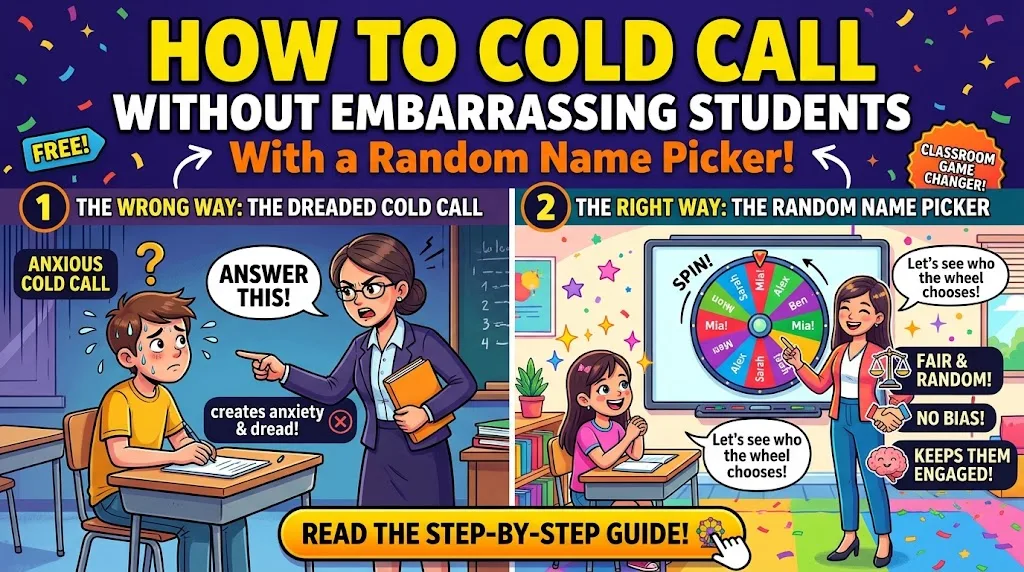
How to Cold Call Without Embarrassing Students, Cold calling doesn't cause embarrassment alone. Surprise, a public examination and the threat of failure do. These can largely be eliminated by explaining, allowing think time, giving an out, asking questions that can be answered and being responsive. A random name picker adds the illusion of fairness. The kindness is yours to give.
By Malik Aiesh Bahadur,
What the research says
The results are inconclusive, and it would be best to admit that fact.
Summaries of the research into cold calling, like the one on Edutopia, describe classes where cold calling only led to shallow listening and student feelings of incompetence and anxiety. They also describe studies reporting that students who were called on usually felt better about participating toward the end of a class and research claiming cold calling helps achieve equity in participation. One study published in 2019 found that anxious students were encouraged to feel more self-assured when teachers focused on measuring effort rather than correct answers.
My analysis of the method is that the approach itself is completely neutral. Its effectiveness depends on how exactly the technique is applied. For instance, Doug Lemov, who popularized the first part of the method, recommends explaining the technique to students and gradually increasing the difficulty of the tasks. In addition, other teachers say that it is possible to implement a more friendly version of the technique that is sometimes called warm calling and implies giving advance notice to students before asking them for an answer.
Why students feel embarrassed
There are always four factors that cause test anxiety.
Surprise: student unpreparedness and lack of time for thought,
A spotlight: the entire class is watching,
The cost of being wrong: an incorrect answer is a public humiliation,
And a feeling of being singled out: a suspicion of personalized judgment.
A random picker eliminates the fourth factor. It does nothing for the first three, which is where your treatment comes in, which the remainder of this article will discuss.
Introduce it before you use it
The first time you ever call on a picker should not be the first person you ask in class. Announce your intentions to the class and explain why. Here's my script for introducing the wheel.
"In this class I'm going to ask questions to everyone, and sometimes the wheel will pick who has to answer. It isn't a trick question. I want to make sure I hear from everyone, not just the kids who raise there hand. Wrong answers are important because they let me know what I need to explain better. If you need more time than you have, you can always say pass and I'll come back to you. Students can ask their peers for help, and I'm looking for thought process not a perfect answer."
Now start calling easy questions to begin with so that you get everyone warmed up, it builds a good rapport. The first couple questions should be very easy questions that any student can feel good about answering like a vocabulary word or a question about the lesson you just taught.
How to run a call
-
Ask the question to your whole class.
-
Wait at least 3 seconds before moving on so everyone is thinking.
-
Spin and say the name of the student with a friendly voice.
-
Wait. Don't rescue the student by filling the silence.
-
Respond to their thinking, not just whether they are right or wrong.
-
Move on, and ask again if they passed.
For more routines that are variations of this idea, see 12 fair participation routines using a random name picker.
Use the picker for warm calls
The trick to combining a random picker with kindness is to spin before the lesson, write the names in your notes, and give a heads-up during the lesson: "I'm going to ask you about question 3 in a couple of minutes."
They get a chance to prepare while you avoid being accused of picking on people. Even thirty seconds of warning is usually enough for a student to work out an answer in secret without the rest of the class waiting around.
Public spin or private spin?
|
|
Spin in front of the class |
Spin privately beforehand |
|---|---|---|
|
Fairness |
Students see the draw and trust it |
Students must trust you |
|
Spotlight |
High. Everyone watches a name come up |
Low. The name arrives quietly |
|
Best for |
Younger classes, games, fun rounds |
Nervous students, sensitive questions, older classes |
|
Risk |
A drumroll can feel like a countdown to humiliation |
Seems less transparent unless you explain |
A good compromise is spinning in public for light rounds and in private for anything more intensive. If you are spinning privately, inform the class and show the wheel to them at the beginning of the term so that they know that it is legitimately random.
- How to Make a Spin Wheel in 60 Seconds
- Pseudo-Random vs True Random: What Teachers and Giveaway Hosts Need to Know
- How to Cold Call Without Embarrassing Students (With a Random Name Picker)
- 10 Vocabulary Review Games You Can Play With a Spin Wheel
What to say in each moment
The words you use after a student speaks matter more than the picker.
|
Moment |
Try saying |
Try to avoid |
|---|---|---|
|
A good answer |
"Thank you. What made you think that?" |
"Finally, someone got it." |
|
A partly right answer |
"That part is right. Who can build on it?" |
A flat "no" followed by "anyone else?" |
|
A wrong answer |
"Thanks for trying that. Here is what it helps me see." |
Moving on instantly, or correcting without thanks |
|
A pass |
"No problem. I'll come back to you." |
"Why not?" |
|
A student who freezes |
"Take a moment. Tell me one thing you're thinking." |
Staring in silence, or "Were you listening?" |
|
A student who gets it right after help |
"Yes. You got there." |
Drawing attention to the help |
Focus on effort and thinking. Phrases such as "I like how you worked that out" keep the point on the work, not on being right or wrong.
Students who find it hardest
Some students have difficulty being called on. This may be caused by anxiety, learning English as a second language, a different processing style or some other reason that you might not think of. There are a few fixes.
Tell the student the question ahead of time, start with an easy question and gradually move up in difficulty, allow the student to pick a partner, let them write a response instead of saying it out loud or let them answer the question in English if they are learning it as a second language.
If there is a support plan for the student, it is best to abide by it. It may include having a name picker in the class but it also should be incorporated into the lesson plan itself rather than a separate plan.
When it goes badly
Occasionally a question may be answered incorrectly. The student may become flustered, flush, or shut down entirely. Never push them. Instead, calmly say something like, "I'll ask that again later. Thanks for giving it a shot," and immediately move on.
After class, be sure to talk to the student individually and ask how they felt about the question and if there is anything you could do to help them in the future. You might be surprised what a student will open up about. Many students will give great feedback that benefits the entire class.
Also, it would be a good idea to cycle through some easier questions to set the class up for success.
Signs the routine is backfiring
Look for these.
Students who avoid eye contact or look away at their desk as soon as your hand reaches for the wheel.
Fewer hands raised going up, and more hands going down.
Students who want to be excused to go to the bathroom the moment you begin.
More "I don't know," answers than before, with no effort to engage their thinking.
If you see these things happening, you need to back up and rethink your practice. Revisit think-pair-share, use more warm calls, ask easier questions, and talk to the class about how they feel. If for particular students this is not working, you need to put the tool back on the shelf. A tool that destroys confidence is not a tool you should have in your belt.
A note to families
If your school or class does something like this it's good to explain what happens from here on out. For example:
"In class we sometimes use a random name picker so that every student gets an equal opportunity to share their ideas. Students can say pass if they need more time, and we focus on effort, rather than getting things right. If your child has trouble speaking in class please let me know so we can solve that problem."
Frequently asked questions
What is cold calling in the classroom?
Cold calling is when a teacher asks a question and expects a student to volunteer an answer. Warm calling is when a teacher hints at questions beforehand.
Does cold calling cause anxiety?
Cold calling can cause anxiety in students when it takes the form of a surprise or as a means of catching students off-guard, even if it is not done often. Explaining cold calling and allowing students to pass, as well as using warm calls can reduce anxiety.
How do I use a random name picker without embarrassing students?
Ask the question and then give a pause for thought before picking a student at random, calling on students fairly and in good faith. Spin the wheel privately if possible and give a heads up to students if needed.
Should students be allowed to pass?
Yes, passing allows a student to opt out of answering, reducing pressure, and the right to call on them again in the future.
Is a random picker fairer than choosing students myself?
Using a random name picker can reduce the possibility of accusations of favoritism and the repetitive use of calling on the same students, though tracking who has been asked throughout the day in a simple tally can accomplish the same result.
How can I help an anxious student?
Give advance warning, start with easier questions, allow the student to choose a classmate to answer with or opt to write an answer, and follow any other accommodations already given by the student.
Try it
Open the Spin Wheel, add first names, and try a warm call tomorrow. New wheels? How to make a spin wheel in 60 seconds teaches, and templates offer more classroom ideas.