Writing Prompt Wheel: 100 Original Story Starters for Five Wheels
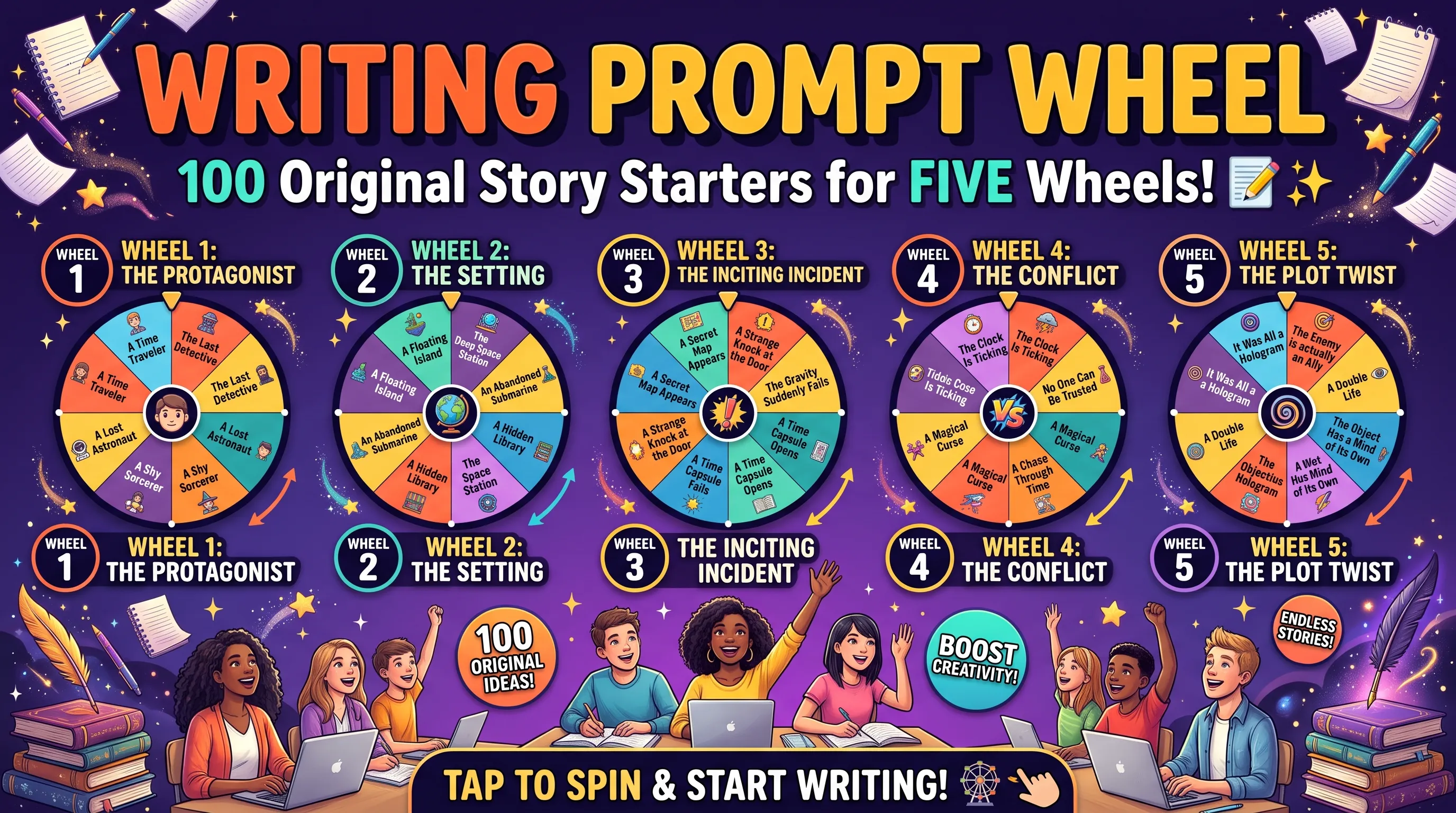
The writing prompt wheel is a fun way to get you started on your story. It randomly picks an idea for you. Below are 100 original prompts split into 5 different wheels. There are 20 prompts for characters, settings, problems, objects and first lines. You can spin 2 or 3 wheels and then combine them to write a story for 10 minutes.
By Malik Aiesh Bahadur,
Why a wheel helps a writer
Sometimes the hardest thing about writing is deciding what to write. The wheel helps by giving a sense of structure and choosing it for you. Often writers will find they perform better when there is a slight restriction. This helps your imagination.
There are also practical reasons. Often lists are skipped over and forgotten. By spinning you are making a commitment, half the battle! All the lists below can be copied into the Spin Wheel. If you’ve never created a wheel before then check out how to make a spin wheel in 60 seconds.
Wheel 1: Characters
- A lighthouse keeper who is afraid of the dark
- A twelve-year-old who can talk to machines
- A retired magician with one trick left
- A baker who never sleeps
- A shy dragon who collects buttons
- A new student who arrived on a rainy Tuesday
- A night-shift bus driver
- A librarian who secretly writes mysteries
- A scarecrow who wants to travel
- Twin sisters who have never agreed on anything
- A boy who collects lost umbrellas
- A robot learning how to tell jokes
- A grandmother who was once a champion swimmer
- A fox who works as a detective
- A cook on a ship stuck in the ice
- A girl who can hear plants talk
- A clockmaker whose clocks all run backwards
- A mail carrier delivering to a town that is not on any map
- A famous explorer who has never left home
- A boy who is the last in his village to learn to whistle
Wheel 2: Settings
- An abandoned train station at midnight
- A school during a snowstorm
- A floating market on a river
- A tiny island that appears only at low tide
- A library where the books whisper
- A desert city built on rooftops
- A space station running out of tea
- A forest where it is always autumn
- A lighthouse on a cliff
- A busy night market
- The top floor of an old hotel
- An underwater bookshop
- A town where it rains only on Fridays
- A hot-air balloon far above the clouds
- A museum after closing time
- A greenhouse on a mountain
- A bus stuck in traffic for hours
- A sleepy village the day before a festival
- A cave full of glowing mushrooms
- A rooftop garden in a big city
Wheel 3: Problems
- The map is wrong
- A secret has to be kept until sunrise
- A friend stops talking to the main character
- Something precious goes missing
- The power goes out everywhere
- A promise cannot be kept
- Two people want the same thing
- A stranger arrives with a strange request
- The main character is late for something important
- A message arrives that was written fifty years ago
- The main character finds out they have been following the wrong rule
- A storm traps everyone inside
- A pet escapes
- A test is tomorrow and nothing is ready
- The only bridge breaks
- Someone has to tell the truth
- A competition ends in a tie
- A door appears where there was a wall
- The main character loses their voice
- Everyone forgets a very important day
Wheel 4: Objects
- A brass key with no lock
- A jar of moonlight
- A broken compass
- A red umbrella
- A notebook whose blank pages fill themselves
- A music box that plays only in the rain
- A single glove
- A snow globe with a tiny village inside
- A rusty bicycle bell
- A letter with no stamp
- A pocket watch that is always five minutes late
- A paper boat
- A lantern that never goes out
- A suitcase heavier than it looks
- A seed that glows
- A photograph with one person torn off
- A tin whistle
- A map drawn on a napkin
- A very old chess piece
- A bag of mismatched buttons
Wheel 5: Opening lines
- The last bus had left an hour ago, but the door was still open.
- Nobody believed me when I said the garden was moving.
- On the day the clocks stopped, I was holding a cup of cold tea.
- The note was short: do not open the blue door.
- My grandfather's hat was waiting on the table when I came home.
- It started with a knock at the window, three floors up.
- The map said the lake was here, but there was only sky.
- I promised I would never tell anyone about the cellar.
- At exactly noon, every bell in town rang a different note.
- The cat arrived with a message tied to its collar.
- I did not plan to become a hero. I only wanted my lunch.
- The river was running the wrong way.
- Everyone in the village knew the lighthouse was empty, except me.
- There was a rule in our house: never whistle after dark.
- The smallest door in the school was always locked, until today.
- She wore one red shoe and one blue shoe, and no one asked why.
- I found the letter inside a library book from 1952.
- When the snow stopped, the footprints began.
- The recipe called for one ingredient I had never heard of.
- By the time I reached the top of the hill, the town below had vanished.
How many stories is that?
By spinning the first four wheels you will have a character, setting, problem and object. There are 20 options on each wheel meaning there are 160,000 combinations to choose from (20x20x20x20). If you add in an opening line there are 3.2 million combinations. You won’t run out!
A 10-minute method
The wheel gives you the ingredients. This routine turns them into a draft.
- Spin (1 minute). Spin the character, setting and problem wheels. Add the object wheel if you want a challenge.
- Plan (2 minutes). Write down three things: what the character wants, what gets in the way, and how things change by the end. That is a story.
- Write (6 minutes). Start writing and do not stop. Do not fix anything yet.
- Share (1 minute). Read one sentence aloud to a partner, or keep it for tomorrow.
If you want to run this every day, a 10-minute habit is more useful than an hour once a week.
When the combination feels odd
Sooner or later you will spin something strange. A shy dragon in a space station with a lost promise and a paper boat does not look like a story. I would say the odd ones are the best ones, but only if you ask the right questions.
- Why is the character here? Answer that and you have a motive.
- What does the problem cost them? Give it stakes.
- What does the object do? Give it a job, even a small one.
- What would surprise the reader? Try the opposite of the obvious choice.
You can allow one reroll. Treat it like a trade: you may swap one wheel's result, but you must accept the others. That stops the wheel from becoming a way to avoid the hard part.
Adjusting for different writers
Younger or reluctant writers. Use two wheels only, such as character and setting. Give a sentence frame: "One day, ___ was in ___ and then ___." Let them draw first.
English learners. Pair each prompt with a picture. Allow a few sentences and focus on getting the idea down, not on perfect grammar.
Confident writers. Add constraints. Write in the first person. Use no more than 150 words. End on the object. Include the opening line in the middle, not at the start.
Adults and hobby writers. Use a wheel as a daily warm-up. Five minutes of flash fiction before work keeps the habit going. Our November writing challenge shows how to build a month of it.
In the classroom
A daily 10-minute write works well at the start of a lesson. A few ideas to make it smoother.
- Teach the process once before you assign prompts, so students know what each step means.
- Let students spin for themselves, or spin on the screen for the whole class so everyone writes with the same prompt.
- After writing, spin a names wheel to choose two or three students to share. See 12 fair participation routines.
- Keep feedback gentle. Ask listeners to name one thing they liked.
- Save drafts in a folder. Students enjoy seeing how much they have written.
If you want to link writing with word study, the vocabulary review games show how to use new words in sentences, and a story is a good place to try them.
Frequently asked questions
What is a writing prompt wheel?
A spin wheel loaded with story ideas, such as characters, settings and problems. You spin it for a random starting point.
How do I use a writing prompt wheel?
Spin two or three wheels, combine the results, plan briefly and write for ten minutes without stopping.
How many prompts do I need?
Twenty per wheel is plenty. With four wheels it gives 160,000 combinations.
Can I use these in a classroom?
Yes. Spin on the screen for the whole class, or let students spin on their own devices. Keep the first sessions short.
What if a student does not like their prompt?
Allow one reroll for one wheel, and ask the questions in the odd combination section.
Can I make my own prompts?
Yes, and I encourage it. Ask students to add their own entries to a wheel, then spin one another's.
Try it
Copy Wheel 1 into the Spin Wheel, do the same for Wheel 2 and Wheel 3, and spin each once. Write for ten minutes. For more ready-made wheels, browse the templates.