When to Let a Yes or No Wheel Decide
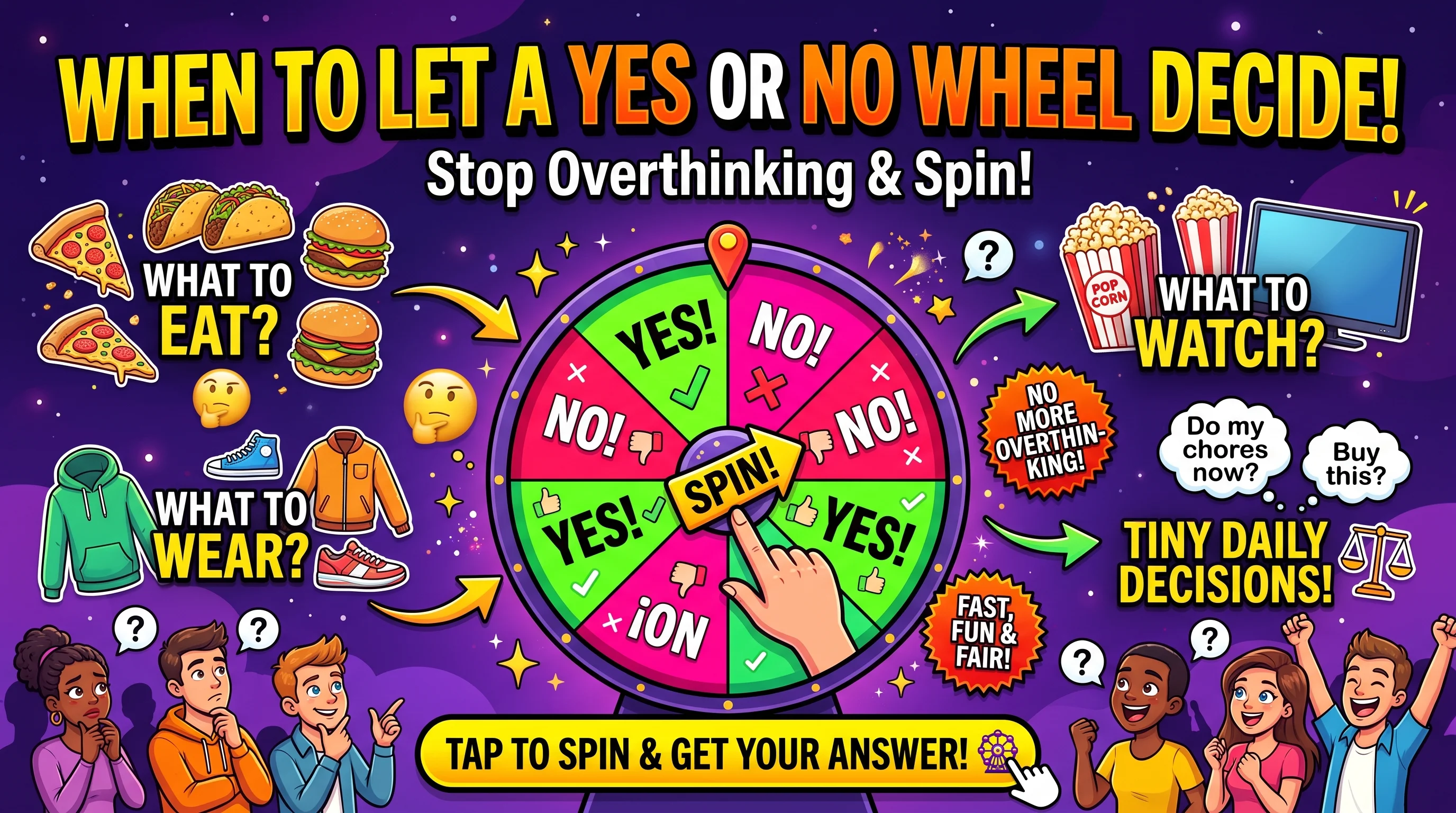
A yes or no wheel is best used on situations where either answer is fine and there is little risk in picking the wrong one. Use it for trivial matters: for instance, to choose where to eat, whether to go out this evening or what to buy. Never use it on an issue relating to your health, safety or that of others, finances or any relationships. In between, use the wheel only as a means of exploring your desires not as a directive.
By Malik Aiesh Bahadur,
A stakes ladder for deciding what to spin
Before you open the Yes or No Wheel, decide how much the answer matters. This is the ladder I would use.
|
Level |
Examples |
What the wheel should do |
|---|---|---|
|
1. Trivial |
What to eat, which film, whether to take the long way home |
Decide, and you follow the result |
|
2. Low |
A small purchase, a weekend plan, whether to message someone back tonight |
Decide, but allow yourself one veto |
|
3. Medium |
Joining a class, rearranging a room, trying a new routine |
Use it as a gut-check, then make your own decision |
|
4. High |
A job, a move, a breakup, a medical choice, money you cannot afford to lose, anything legal or involving safety |
Leave the wheel out of it. Talk to people who know the situation |
Most of the confusion about these tools comes from people skipping straight to level 4 because a wheel feels like it should be able to help. It can help a little at level 3. It should not decide at level 4.
The gut-check trick
This is the most useful function of a yes or no wheel, and one rarely mentioned by sites.
Write the question. Spin. When the wheel stops, take a moment to analyze your initial reaction to the outcome before you begin rationalizing it. A wave of relief or disappointment, the urge to spin again, is valuable information.
Make the decision for yourself; the wheel served its purpose by forcing you to react to a potential answer rather than think it through. Many people have found they really wanted the opposite answer from the one they got, and the wheel is great for breaking mental blocks on questions.
Use it on dilemmas you're actually conflicted about; if you know the answer already, you'll feel it and be wasting your time spinning.
What the research says
There is one fascinating study worth mentioning. An economist by the name of Steven Levitt asked visitors to his site to flip a coin on a screen, in order to make a decision they were struggling with. Over a year, more than 20,000 coins were tossed, on issues ranging from changing a hairstyle to quitting a job or leaving a relationship. The players were contacted two and six months later.
When it came to important decisions, those who were advised by the coin to change something were more likely to do so and were happier with their six-month result than those who, following the advice, did not. Levitt concluded that we often tend to be too conservative in the face of change when we are on the fence. The paper, published in The Review of Economic Studies in 2021, certainly suggests this.
I would read this paper carefully. The participants were volunteers, who had already made a decision and just didn’t know it – the happiness was self-reported; Levitt himself spoke of the result as merely “suggestive”. This does not say that every one of us should get a coin in our life. What it does say is that if you are really on the fence, a random push one way or another will get you off it – and in the long run, it did not matter in this study what the choice was. It is a small sample size, and a study of the undecided, but I would not underestimate it.
You will often read that wheels reduce decision fatigue – that is, the tiredness we feel from making too many choices, especially smaller ones. The science of this is more complicated than the soundbite, but I will not go into it now. What I will say is small choices drain your time – and a wheel spins it away in ten seconds.
How to ask a good question
A yes or no wheel will only answer the question you ask it, so a vague question produces a vague answer.
Make it a single decision. "Should I eat Thai tonight?" is good, but "Should I go out and eat Thai or Italian?" is two questions disguised as one.
Make it specific and limited. "Should I go for a run this evening?" is better than asking if the person should exercise more.
Make a default choice for decisions with a range of choices. If you're deciding between five different restaurants, pick your favorite and ask if you should eat there. If the wheel comes up with a no, eliminate that choice and ask again, or put all five restaurants on a Spin Wheel and ask the question as you normally would.
Frame it so that either answer is acceptable. If an answer of no would bother you, it's a level 4 question in disguise.
What to do with Maybe
Some wheels provide a third slice and so have answers Yes, No and Maybe. This gives each of the three answers a probability of 1/3.
Maybe is a satisfactory answer if given a specific role. Assign a meaning to it. My idea for the meaning is that Maybe will mean that there is a deadline by which the choice must be made and if it is not made by then the answer is no.
Rules that stop you cheating yourself
The easiest way to sabotage a yes or no wheel is to keep spinning until it gives you the answer you want. Decide on the conditions before you begin spinning.
One spin only. If you're going to do a best of three, you've decided what you want anyway, and the wheel is just a prop. That's not a terrible lesson to teach, but it is a lesson nonetheless.
One veto, for level 2 questions only, at the most.
Write the question and the answer down. It keeps you from changing your mind later.
Using it in a group
A wheel is excellent for breaking up little standoffs. Whose turn is it to choose the movie? Do we leave now or in ten minutes? The situation is easiest to resolve when neither side can claim responsibility for the outcome.
The problem is the question. Whoever writes the question has control over the outcome, since "Should we eat at my favorite place?"is hardly a neutral statement. Have the dissenting party write the question, or have someone impartial do it.
When a different tool is better
If you have the choice between two options and you want to make something simple and quick, a coin toss serves the exact same purpose. Our comparison of spin wheels, coin tosses, dice rolls and name draws from a hat will highlight the key differences.
If you are undecided about something that is of a serious concern, a written list of pros and cons often helps more than a spin wheel. I compare the two methods in the article Yes/No/Maybe wheel vs a pros and cons list.
If you are thinking about a big purchase, try the Should I Buy It wheel, and then wait 24-hours before purchasing.
A note about big decisions
A wheel is a source of fun and a way of helping you think through a problem. It is not a substitute for professional advice. Wherever you need advice on your health, money, legal affairs, safety or relationships with other people, always consult someone who can give you expert advice such as a doctor, an adviser, a lawyer or someone you trust. If you are facing a difficult decision, it is a good idea to talk it over with someone, rather than leave it to chance.
Frequently asked questions
Is it a good idea to make decisions with a yes or no wheel?
For small decisions where either answer is acceptable, yes. For important decisions about health, money, safety or relationships, no. Ask for help instead.
Is a yes or no wheel truly fifty-fifty?
Given a wheel with two equal parts and a function that randomly picks a number, each with have a 50 percent chance to appear. Adding another part labeled Maybe would make each choice have a 33 percent chance to appear. See how to determine a winner on a spin wheel.
What should I do if I don't like a choice?
Focus on the feeling. What does it say about your decision? Decide for yourself.
Can a coin toss really help with difficult choices?
A study that asked uncommitted individuals to make a choice using a coin toss and reported being happier with their results six months later shows encouraging results for this method. Beware that the results are anecdotal as they are based on self-reporting and should be used as motivation instead of absolutes.
Should I spin again if I don't like a choice?
The short answer is that if you are looking for an out, the wheel is not the right tool. Come to an agreement about spinning again before beginning.
What does the Maybe choice mean?
Decide the meaning ahead of time. A good rule is that it means you have to make a choice by a certain time, and no if you haven't.
Try it
Pick a level 1 or level 2 question, write it down and spin the Yes or No Wheel. Notice your first reaction. For other quick decisions, browse the templates.